As the universe expanded, another problem appeared: none of this could remain merely a collection of interesting ideas.
Creating a planet, a civilization, or a new technology was easy. The difficult part was making all of them coexist in the same universe without contradicting one another. A decision made in one place produced consequences somewhere else. If I gave a technology a certain capability, I also had to know why it was not being used elsewhere in the story. If I created a particular political structure for a civilization, I had to think about the historical conditions that had produced it. If a character knew something, I had to account for when and how that character could have learned it.
That way of thinking was not unfamiliar to me.
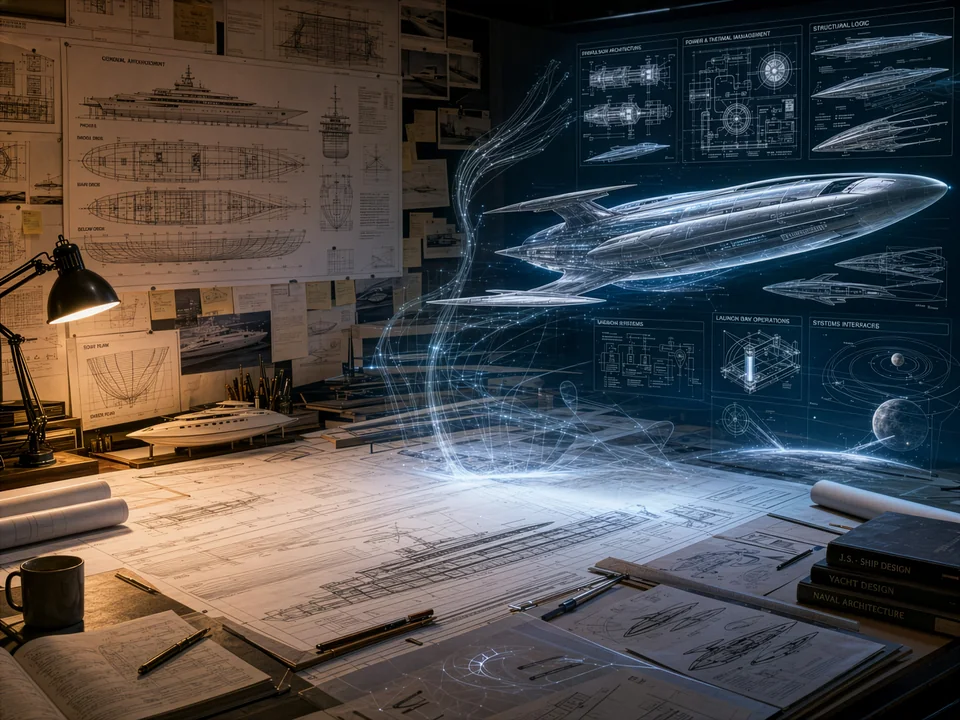
Naval architecture, marine engineering, and project management had taught me throughout my career that complex systems are not really made up of independent parts. On a ship, you cannot think of the hull, machinery, electrical systems, ventilation, accommodation, safety, or operations as completely separate things. A decision in one area often affects another system. A change that looks small on paper can become a major problem elsewhere in the chain.
While writing P.X, I found the same reflex coming into play almost without my noticing it.
Its main contribution was not technical detail so much as a way of thinking about relationships. A starship implied the resources, institutions, command structure, and culture that made it possible. But as the universe expanded, the real challenge emerged somewhere else: not putting everything I had built into the novel.
Simply giving different civilizations different-sounding names did not feel sufficient. Names from the same culture had to sound as though they truly came from the same place. Sounds, syllables, and word structures needed a certain internal consistency. Over time, I began developing fragments of language, word roots, and naming systems for some of the civilizations.
A character’s name, a planet, a ship, or an institution could no longer be simply a word that sounded good. As far as possible, the name had to carry some trace of the society that used it.
Sometimes a few words generated another set of questions. What did a society choose to name? Which concepts mattered enough to deserve distinct terms? Would two civilizations describe the same event with the same language? How did they understand time, duty, authority, family, or death?
Thinking about language forced me to think more deeply about the cultures themselves.
Because giving a civilization a different appearance was not enough to make it truly different.
What had happened in its past? What did it fear? What did it value? How did it understand power? Was war an ordinary political instrument, or a reminder of a historical trauma? What was the relationship between the individual and society? How old were its institutions? What marks would thousands, even millions, of years of history leave on present-day behavior?
This was where I began to understand the difference between engineering and writing: engineering helped me build the world; writing taught me how much of that world I actually needed to show.
Not every answer to those questions belonged in the novel.
I learned that gradually.
At first, I thought the world I was building needed to be as complete as possible. In engineering, you do not want gaps in a system. Missing information is risk. If there is a problem, you solve it. If there is uncertainty, you try to eliminate it.
Writing a novel taught me something else.
The reader did not need to know everything.
Sometimes it was better if they did not.
I needed to know that a civilization had centuries or millennia of history behind it, but the reader might need to see only a small part of that history. It was important for me to understand how a technology worked within my own internal logic, but putting the entire explanation into the novel did not make the story better. Sometimes a detail I had spent months thinking about survived in the book as a single sentence.
At first, that felt a little ruthless.
Then I began to understand that this was simply part of writing a novel.
The same was true of characters.
When you design a system, you want its components to behave predictably. People do not. Characters should not either.
A novel populated by people who always chose the most logical option would probably be very orderly and very dull. People become afraid, make mistakes, grow angry, fall in love, carry their pasts with them, and sometimes make decisions that are difficult even for themselves to explain. No matter how large the cosmic scale of P.X became, all of that still had to remain at its center.
That, too, was a different kind of learning process for me.
Sometimes the engineer in me wanted to solve a problem while the writer in me knew that the problem should remain unresolved. Sometimes I wanted to explain something I knew about the world, while the story required that it not yet be said. And sometimes an idea I had worked on for a long time had to be left behind if it did not serve the scene the characters were actually in.
Gradually, those two ways of working learned to live together.
The engineer gave the world its skeleton.
The writer tried to make people live inside it.
Meanwhile, P.X kept growing. New characters, places, and histories appeared. A small detail established in one place could become important hundreds of pages later, while an earlier decision could define the limits of something that happened much further on. The story was beginning to develop a memory of its own.
The work was no longer only about producing new ideas. It was also about remaining faithful to the rules of the world I had already created.
And through all that complexity, the pages kept accumulating.
A handful of questions that had once wandered through my mind on train journeys had become a real story inside a world with characters, histories, cultures, languages, technologies, and its own internal logic.
A point that had seemed impossibly distant for a long time was slowly getting closer.
One day, I was no longer thinking about how to build a new world.
I was approaching the end of the novel I had been writing.
And eventually, that moment came.
The first complete manuscript of P.X: No Man’s Space was finished.
At the time, I thought this was the greatest turning point in the journey.
I was right.
Just not for the reason I thought.




Discussion
Please mark book spoilers clearly. First-time comments are reviewed before appearing. Your email remains private.
No comments yet. Share your thoughts below.