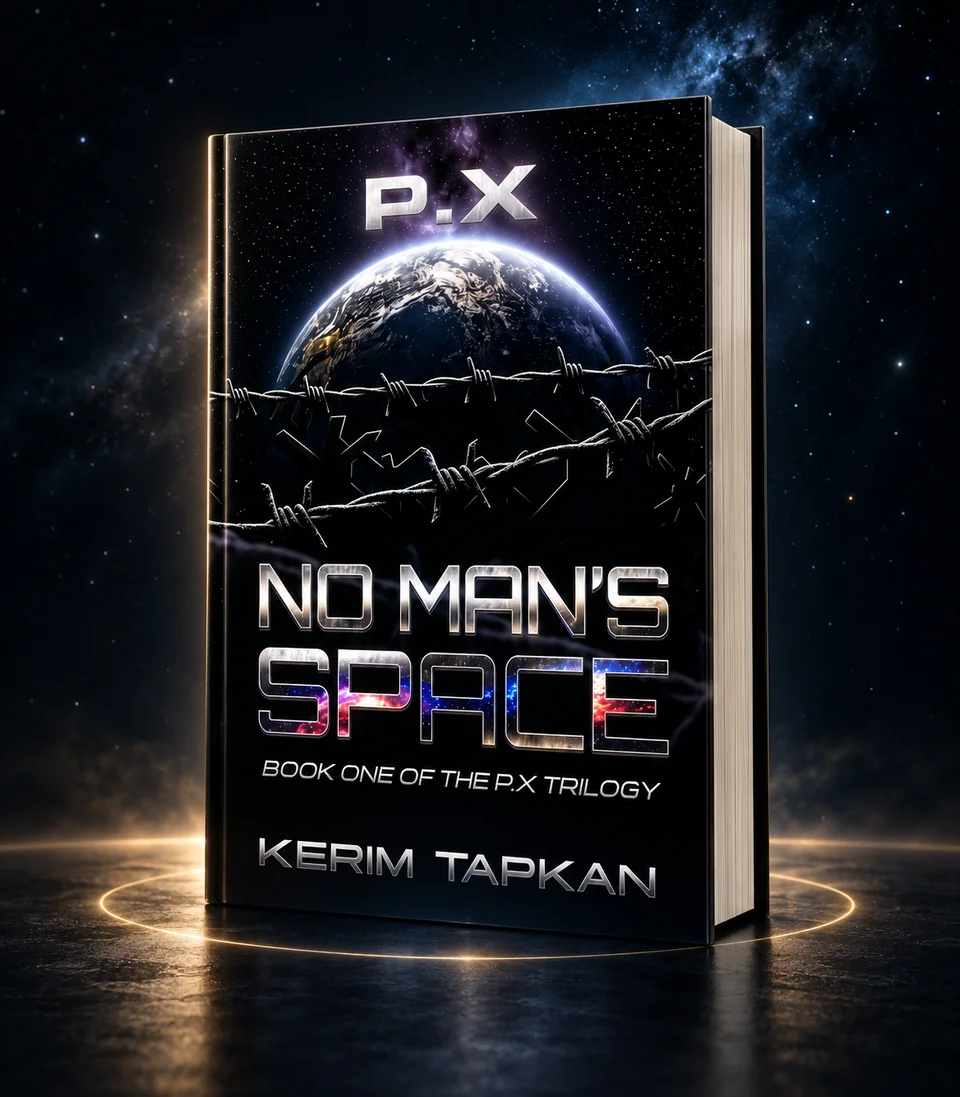
Months later, when the Second Edition was published on August 1, 2026, P.X existed in the real world in all its formats. It had been written, edited, designed, and printed; it had a cover, an ISBN, physical editions, and a page on Amazon where people could find it.
For a long time, I had thought that was the entire goal: write a book and publish it.
But after publication, I encountered a very simple reality:
The fact that a book exists does not mean people know it exists.
For an independently published book in particular, publication day is less a finish line than the beginning of another process.
P.X was not going to appear by itself in the middle of a bookstore window. There was no publisher’s sales and marketing team waiting to put it in front of readers. No press department was going to call editors, send review copies, or tell journalists the story behind it.
If those things needed to be done, I would have to do them as well.
Once again, I was standing in front of a field I did not know.
And now the question was:
How do you put a book in front of people who have never heard of it?
The first thing I realized was that I could not tell everyone the same story.
A reader might be curious about the premise of P.X.
A book critic might want to understand its genre, structure, and narrative.
For a journalist, the more interesting story might not be the book alone, but the fact that a naval architect in Türkiye had written an English-language science-fiction novel.
For a maritime publication, the connection could be different again: someone who had spent his professional life around real ships and complex projects applying the same way of thinking to imaginary civilizations and starships.
P.X was the same book.
But the doors into it were different.
So I began by building the material needed to explain the book properly.
I prepared book-information sheets in Turkish and English, promotional texts of different lengths, and author biographies. I assembled cover images, photographs of the physical editions, author photographs, a review copy, and sample sections that could be used when the full novel was not required.
I also realized that the Vienna and Ballhausplatz story deserved to exist as a piece of material in its own right, so I created a separate visual document for it.
Before long, I had a small media archive in front of me.
I no longer had to begin from zero every time I wanted to explain the book to someone.
But preparing the material was only half the job.
I had to find the people to send it to.
I began researching book-review sites. I looked at blogs, independent reviewers, cultural and literary platforms. I checked what genres they read, how they accepted submissions, and whether they wanted files at all.
I discovered platforms such as BookSirens, which connect independently published books with potential reviewers, and prepared a review campaign for P.X.
While doing all of this, I was learning something else as well.
Promoting a book is not the same as praising it.
I could believe that P.X was good. I had spent two years on it. I knew its world, its characters, and every small detail inside it.
But my belief could not replace the opinion of an independent reader.
What I really needed was for people who did not know me to open the book.
They might like it.
They might not.
There was now an area I could no longer control.
While writing, I had made every decision.
During publication, I had still controlled most of the process.
But the moment a real reader sat down in front of the book, that control ended.
I think this was one of the hardest and most necessary thresholds in the journey.
For two years I had protected P.X, corrected it, changed it, and tried to make it as ready as possible.
Now I had to place it in front of strangers.
And to do that, I had to start knocking on doors.
Quite a lot of them.





Discussion
Please mark book spoilers clearly. First-time comments are reviewed before appearing. Your email remains private.
No comments yet. Share your thoughts below.