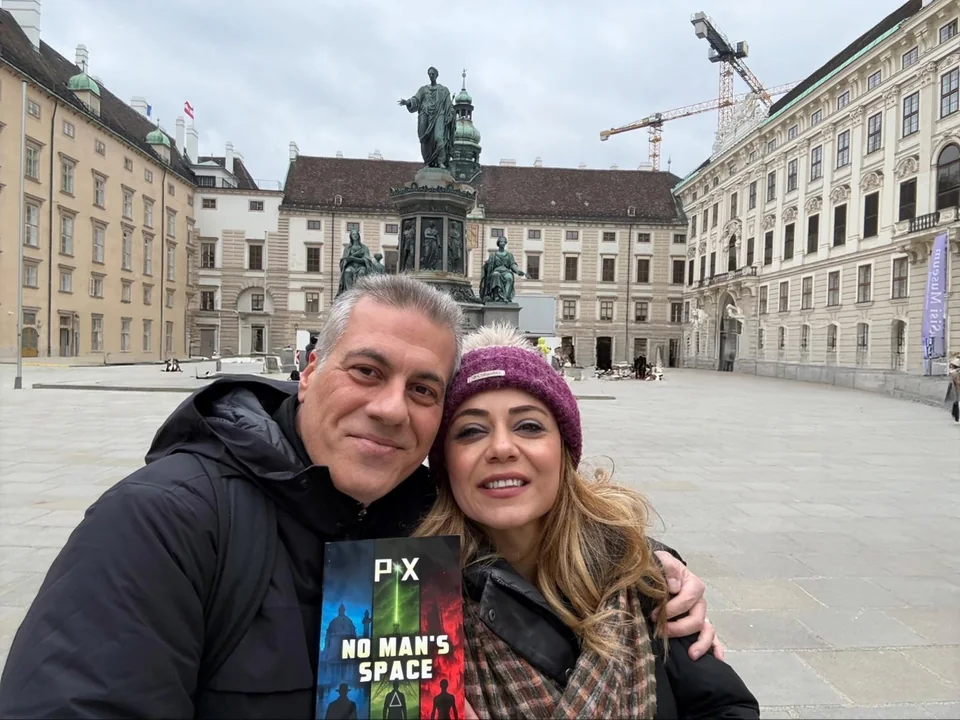
Throughout this process, there was someone who may have been even more optimistic about P.X than I was.
Fulya.
She had been there when the book was still only an idea. She was also the one who had suggested, on my journeys home from work, that I try listening to podcasts instead of music or playing games on my phone. Neither of us could have known that such a small suggestion would become one link in the chain that led me to StarTalk, and from there to finally writing the story that had been sitting in my head for years.
Two years later, she was holding the hardcover edition of P.X.
And she had no intention of keeping it to herself.
She took the book to her office.
She showed it to people.
She told them about it.
If someone was interested, she told the story again.
Because I had spent so long looking at every detail of the book from the inside, I was usually focused on the next thing that still needed to be done: the file that needed correcting, the email that had to be sent, the message that required a reply, or the next target that had not yet been reached.
Fulya was looking from slightly farther away.
What she saw, I think, was different.
One day, I had decided to write a novel.
Then I had actually written it.
In my second language.
I had built a world, rewritten it again and again, prepared everything from the cover to the interior design, and eventually turned it into a physical book.
Over time, I understood more clearly that what made her proud was not only the story inside P.X.
It was the fact that the book had been made.
That an idea had not been left unfinished.
Perhaps that was why seeing the book in other people’s hands began to affect me differently than I expected.
Someone looking at the cover.
Turning the pages.
Asking a question about it.
None of these were major events.
But each one meant P.X was moving a little farther away from me.
In a good way.
One of the films I have loved throughout my life is Back to the Future. In one of the final scenes, which I watched again and again when I was young, George McFly opens a box containing copies of his newly published first novel. The book is called A Match Made in Space. He picks up the hardcover and says the line we all remember:
“You put your mind to it, you can accomplish anything.”
When I first saw that scene, I could not possibly have imagined that one day I would be holding the hardcover edition of my own science-fiction novel.
Years passed.
One day, a hardcover copy of P.X: No Man’s Space was sitting on my desk.
And Fulya was picking it up and showing it to everyone around her with almost the same enthusiasm as Lorraine McFly.
The parallel affected me more than I expected.
I knew every flaw in P.X.
I knew which passages had been rewritten.
I knew how many hours I had spent on certain words, how many times particular chapters had changed, and which version number a cover file had eventually reached.
Fulya simply picked up the book and saw something much simpler:
“You made this.”
Perhaps that was when I finally recognized something I had not quite been able to name when I first held the book myself: P.X was no longer only mine.
I still had no idea how far it would go. But other people were touching it, talking about it, and beginning to form their own opinions.
That, in the end, is what it means to put a book into the world: at some point, you have to allow it to stop belonging only to you.





Discussion
Please mark book spoilers clearly. First-time comments are reviewed before appearing. Your email remains private.
No comments yet. Share your thoughts below.