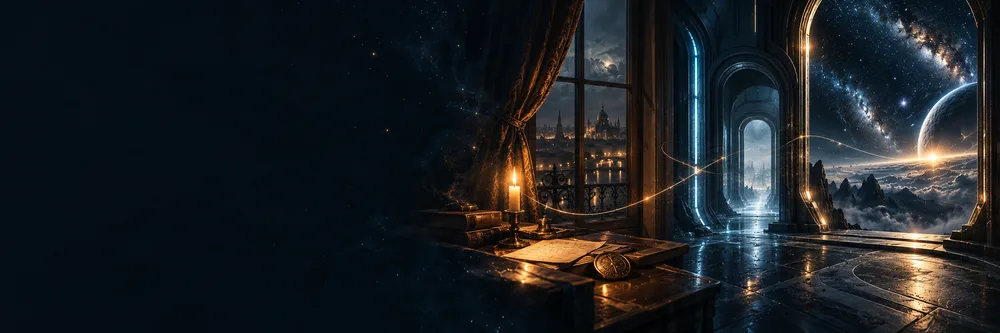
When I started writing, the central idea in my mind was first contact.
I was thinking about the moment when humanity learns, beyond any possible doubt, that an extraterrestrial civilization exists. Science fiction had shown us this many times: ships appearing in the sky, an incoming message, an unexpected visitor, a world order transformed overnight. What interested me, however, was less the contact itself than the questions that would come immediately afterward.
What would actually happen if something like that became real?
How would governments react? What would scientists say? How would militaries respond? Would people be afraid, excited, or unwilling to believe it? And more importantly, why would the civilization on the other side have contacted us in the first place?
At first, these seemed like natural questions belonging to the story. But as I kept writing, every answer began producing another question.
If a civilization advanced enough to reach Earth existed, could it really be alone in the universe?
Probably not.
Then there had to be other civilizations as well.
Did they know about one another? Had relationships formed between them? Did they trade? Did they have borders? Alliances, conflicts, treaties, shared rules? How would politics function in a galaxy containing civilizations that had existed for millions of years?
And where did Earth fit into all of this?
One of the things I least expected while writing P.X was this: every answer created a new question.
At some point, I realized I was no longer thinking only about a civilization coming to Earth. I was thinking about the world it had come from. Then about the other worlds connected to that world. Their histories, old disputes, alliances, fears, interests, and the ways they viewed one another.
In short, I had stopped designing aliens and started designing the universe they lived in.
Technology was only one part of it. Thinking about how a starship worked inevitably led to asking who had built it, why it had been built, and within what kind of system it existed.
Those questions expanded the world of P.X from ships to planets, from planets to societies, and from societies into history. Different civilizations had to be distinct not only physically, but in the ways they thought, the political structures they created, and the pasts they carried with them.
It was easy to say that a civilization was ancient. Convincing a reader that it truly had millions of years of history was much harder. Advanced technology alone was not enough. There had to be memory, institutions, traditions, fears, and burdens inherited from the past.
P.X therefore began to grow not only forward into the future, but backward into history.
That was when Vienna in 1815 entered the story.
The Congress of Vienna was a period in which Europe’s political order was being rebuilt after the Napoleonic Wars. Powers came together, borders were redrawn, and the balance on which the future order would rest was being negotiated. Unexpectedly, that setting echoed some of the questions P.X was beginning to ask on a much larger scale.
Who determines the order?
Who gets to decide?
Can decisions about a society’s future be made without that society even knowing?
And most importantly:
What if humanity’s relationship with this larger story had begun long before the moment we would call “first contact”?
That question changed the structure of P.X for me.
I no longer had only a first-contact story set in the future. A larger structure was forming, stretching from the past into the future, with different periods connected by invisible threads. Vienna in 1815 and the Earth of the future became two distant points in the same story.
Within all that scale, however, the story still needed a human center.
Kai Carson became part of that center.
The fact that Kai is a naval architect was, of course, not accidental. It felt natural to take someone from a professional world I knew, someone accustomed to looking at systems and problems in a particular way, and place him inside a reality far larger than anything he could understand.
But Kai’s role was not to explain the P.X universe.
Quite the opposite. He needed not to understand most of it either.
Because the reader would learn alongside him.
Rather than beginning with a character who already understood the galaxy’s political structure, the history of ancient civilizations, or Earth’s true place within that order, it seemed more natural to let the world open through the eyes of someone living within the limits of an ordinary human life. As the scale of the story grew, Kai’s perspective became the reference point that kept bringing it back to a human scale.
But the P.X universe kept expanding.
Some characters’ pasts no longer fit inside the main story. The histories of certain civilizations had become too large to pass over in a few paragraphs. Events that appeared only as brief traces in the background of the main novel began to reveal stories of their own.
At some point, I realized I was no longer thinking within the limits of a single book.
The story had expanded.
What had begun as one novel was becoming the first part of a larger narrative. The structure of a trilogy began to take shape, while around it appeared the outlines of other stories that could reach into what came before the main story, what happened between its parts, and what might come after it.
As this world grew, something else also became increasingly clear: its name. P.X.
One of the questions I am still asked most often is what those two letters mean. I do not think it would be right to answer that here, because the meaning of P.X is a secret that emerges as the novel progresses and connects to an important part of the story. For now, all I can say is that the letters were not chosen at random. The answer should remain inside the book.
At that stage, I still did not know where all of this would lead.
But one thing had become clear.
I had started out writing a first-contact story.
Without realizing it, I was building a universe.





Discussion
Please mark book spoilers clearly. First-time comments are reviewed before appearing. Your email remains private.
No comments yet. Share your thoughts below.