Marine Technology (MT) · October 2026 edition · By Kerim Tapkan
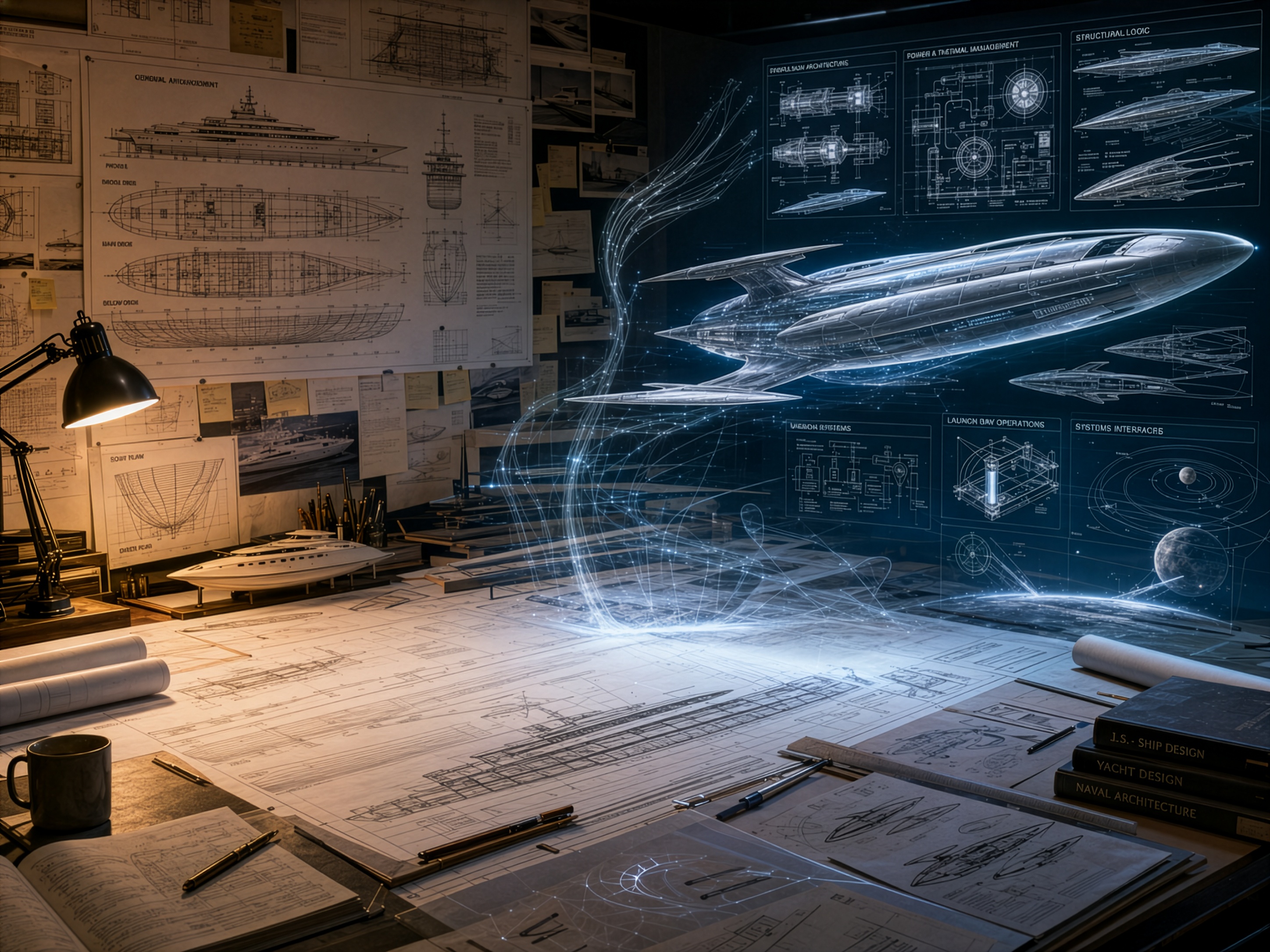
Science fiction gives an engineer a privilege real shipbuilding never does: the freedom to change the rules of the problem.
Gravity can be manipulated. A field can protect a hull. A drive can cross distances known physics would make impractical. Speculative fiction has to be allowed to speculate.
Long before writing P.X: No Man's Space, a first-contact science-fiction novel and the opening book of a trilogy, I noticed that I rarely encountered fictional vessels without my professional habits interfering. Why do so many warships put the bridge at the most exposed point on the hull? Why are fighters still shaped and flown like aircraft, with one forward thrust axis, when nothing in vacuum requires a pilot to face the direction of travel? And where does all the waste heat go?
Arthur C. Clarke later recalled that Discovery in 2001: A Space Odyssey was meant to carry large radiators to reject reactor heat, but they were removed because audiences might read them as wings. It was a defensible cinematic choice, but also a revealing trade: recognizable visual language overrode a real thermal requirement. After years asking such questions about real vessels, they become difficult to switch off.
Speculative science need not be achievable today to be believable. Engineering does not make an invented propulsion system real, but it helps define the assumption and test whether it behaves consistently. What breaks the illusion for me is not an impossible technology, but an ignored consequence.
In naval architecture, that instinct belongs to the design spiral. Each pass revisits the vessel as interacting requirements become clearer. Developing P.X, I found the same habit extending into fictional technologies, spacecraft and eventually civilizations.
The speculative leap may be free. Its consequences are not.
Different environment, familiar questions
A ship's hull form is shaped by buoyancy, stability, resistance, seakeeping, volume, propulsion and structure. Move the vessel into space and many of those constraints disappear.
Conventional intact stability and wave-making resistance disappear. Propulsion need not transmit mechanical power aft to a propulsor, and watertight subdivision no longer protects reserve buoyancy.
Hydrostatic stability gives way to mass properties, attitude control and thrust alignment. Hull-girder and wave loads may be replaced by acceleration, pressure, propulsion and thermal load cases. Watertight subdivision becomes pressure-tight casualty containment. Propulsion gains positional freedom, but power supply, heat rejection, structural load paths, redundancy and failure modes remain.
Speculative technologies add another layer. If gravity manipulation reduces conventional weight constraints, what happens on power loss? If a force field is primary protection, what remains behind it? If FTL changes the meaning of range, what does it do to power, navigation or crew endurance?
Removing familiar constraints also forced me to ask why they exist. It becomes easier to distinguish constraints imposed by physics from solutions inherited through generations of ship design. Speculative design is no substitute for real engineering, but as a thought experiment it can reveal what a familiar constraint was doing and what must replace it.
The vessel is only part of the design
That approach changed how I thought about the spacecraft in P.X.
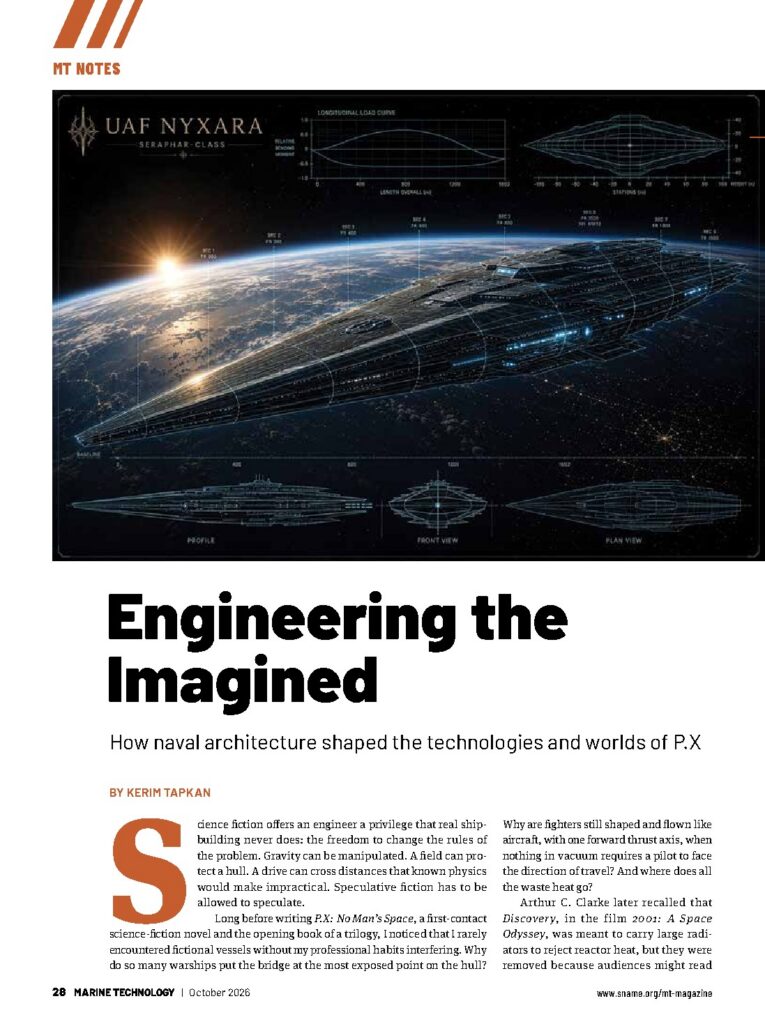
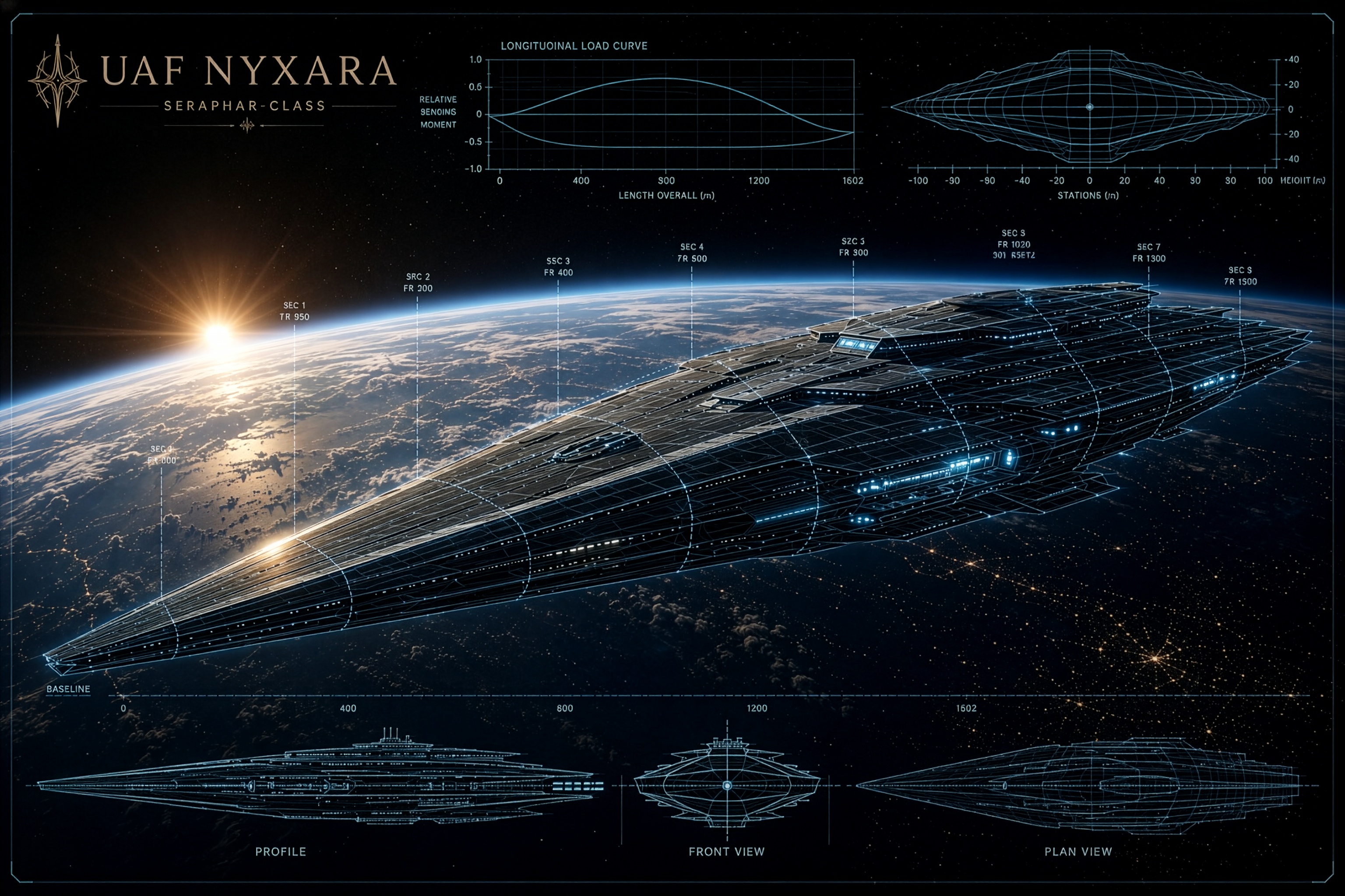
The Seraphar-class UAF Nyxara and the Qorzan-class Qorvax could not simply be different shapes carrying different technologies. Their civilizations, missions and doctrines had to produce different answers. The same question about fighters eventually produced a design in which orientation and direction of travel are separate problems, because nothing in vacuum requires them to be the same.
The question became larger than, "What should this spacecraft look like?" It became, "What kind of civilization would have built it, and why?"
That is where naval-architecture thinking began turning into speculative worldbuilding. In one case, the route to the spacecraft started not with the vessel, but with its home planet.
Working backwards from an invented world
While developing a forthcoming story around Arcanis Prime, I had fixed its day, the vaeren, at about 21.5 Earth hours, and a 400-vaeren year. Instead of leaving those as arbitrary units, I tested whether they could be reconciled with a plausible orbital model.
A simplified form of Kepler's third law gives the governing relationship, with orbital period in Earth years, orbital radius in astronomical units and stellar mass in solar masses:
P2 = a3M
With a 0.99-solar-mass star and a 0.985-AU orbit, the resulting year is within about half a day of the 400-vaeren calendar; the difference is handled through intercalation.
Then the orbit started adding consequences of its own. A modest eccentricity produces about 32 percent more sunlight at perihelion than at aphelion, compared with roughly 7 percent for Earth. With perihelion near northern midwinter, it moderates northern seasons while sharpening southern ones.
The calculation was not decoration. A fictional calendar had constrained an orbit, and the orbit had begun constraining the environment.
When orbital mechanics reaches the accommodation plan
Each vaeren contains 1,000 ren. Combined with the planet's axial tilt and its principal inhabited latitudes, the model gives about 400 ren of daylight at midwinter and 600 at midsummer. Those figures became biological thresholds for partial and full physiological regeneration.
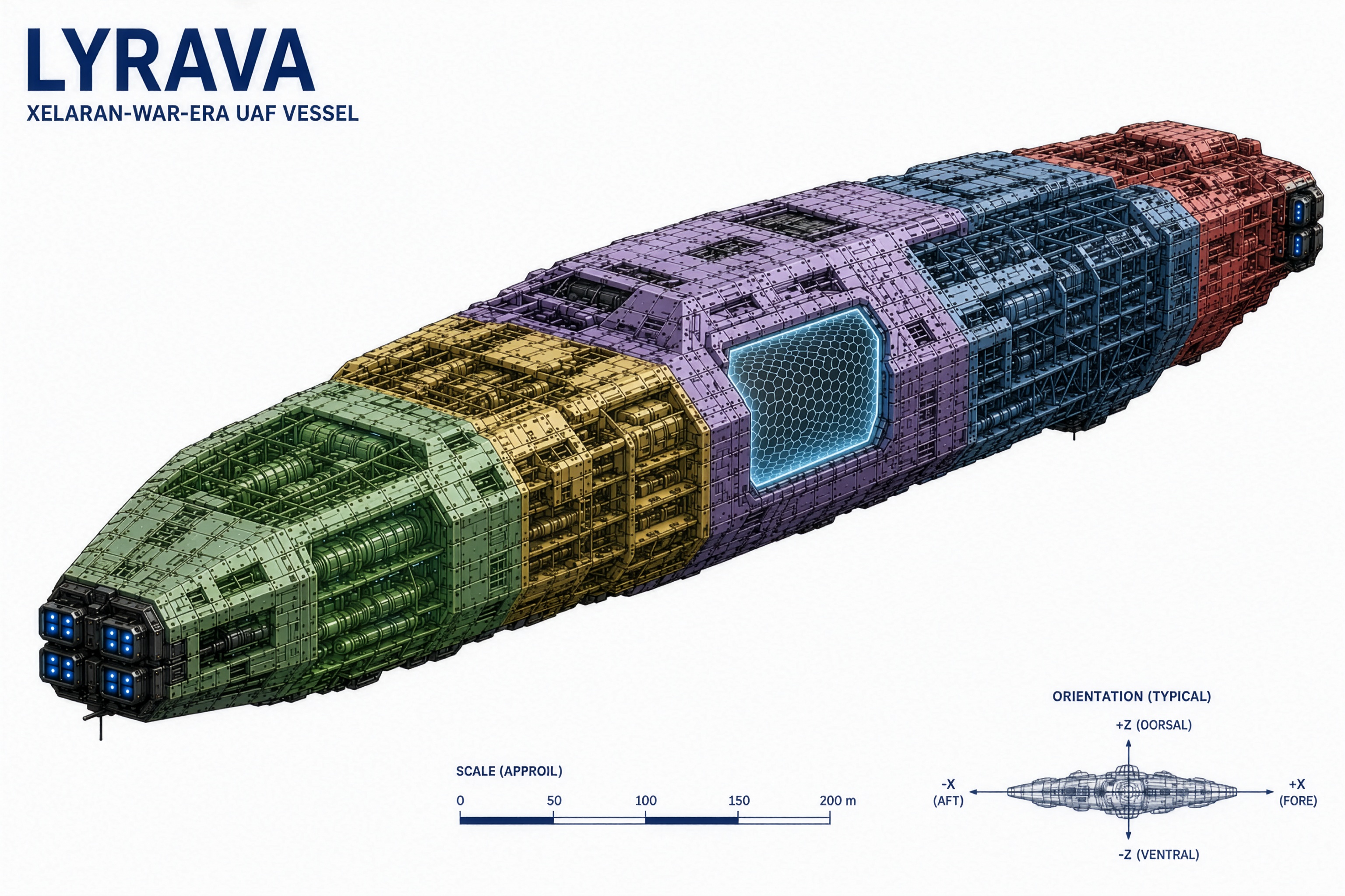
A full reset requires 600 ren; shorter 400-ren recoveries can leave stabilization debt. Once I chose the biology, it began making design decisions for me. A daylight calculation had become a crew-rest requirement, affecting watchkeeping, endurance, medical monitoring, crew rotation, environmental control and space allocation. On the Lyrava, an earlier Xelaran-war-era vessel, regenerative sleep became shared infrastructure, with chambers adapting geometry, pressure, temperature and monitoring to their occupants.
Arcanis is also home to more than one hundred sentient species, so no single body plan, atmosphere or nutritional chemistry could serve as the default. Adaptive interfaces, environmental zones and species-specific nutrition therefore became normal shipboard requirements rather than special accommodations. Once the crew ceased to be a single species, even habitability had to be reconsidered. A technical requirement had become cultural worldbuilding.
Requirements also arrive from outside the ship
The process also works in the opposite direction. The Xelaran Conflict develops through supply lines, choke points, refinery dependencies and overstretched assets, not simply fleet battles.
A border or Neutral Zone demanding rapid intervention creates a response-time requirement. If meeting it makes a vessel excessive in power, range or support demand, the answer may be forward deployment, distributed assets or different doctrine.
Politics creates vessel requirements, and engineering can push back. The ship is where the consequences meet.
From designing vessels to designing worlds
Once I began following those consequences in both directions, the design spiral no longer stopped at the vessel's boundary.
A propulsion assumption can alter strategic reach. Biology can reshape shipboard architecture. Planetary mechanics can influence biology. A mature civilization should also accumulate standards, preferred interfaces and institutional memory.
The chain can travel surprisingly far. Three of Arcanis Prime's four moons form a 1:2:4 orbital resonance. The resonant trio's regular tidal beat created a persistent planetary rhythm that informed vibration-sensitive Chordwood forests and, in turn, resonance-aware architecture aboard Arcanian ships.
None of that was required by the original calculation. Each answer simply invited the next question: if this is true, what else should also be true?
The more I followed those consequences, the less I was designing individual spacecraft and the more I was designing the civilizations capable of building them.
Most of this work never appears in the story. The background engineering appears not as exposition, but as behavior. A fighter rotates independently of its trajectory. A crew-rest cycle becomes rationed resource. A different physiology changes a compartment. The reader is not shown the orbital equation behind a season or the design study behind a spacecraft arrangement. Nor should they be.
The reader never needs to know the formula. The world does.
And, for reasons I am not entirely sure I can explain, I have enormous fun doing this. I can spend hours on orbital periods, biological rhythms, fleet logistics or a fictional technology knowing that perhaps none of it will appear explicitly on the page. That invisible structure makes the P.X universe feel livable to me before I ask a reader to believe in it.
That is how credible speculative fiction should be built: the background need not be explained, but it should exist. The visible story should rest on an invisible structure of cause and effect.
The next turn comes from experience
One more naval-architecture habit proved useful: design does not stop when a vessel enters service.
Real ships generate operational evidence, revealing which assumptions worked and what the next generation should change. A fictional fleet can do the same.
The Lyrava belongs to an earlier Accord era. Its wartime pressures can feed later design thinking represented by vessels such as UAF Nyxara. Among the Accord's adversaries, the Qorvax lineage evolves as technology, threat and doctrine change.
The familiar feedback loop remains:
requirement → design → operation → evidence → lessons → new requirement
Once a fictional vessel has a service history, its successor can no longer be designed on a blank sheet. The earlier vessel has become part of the requirement.
Engineering the imagined
None of this means naval architects currently know how to design the spacecraft of speculative fiction. We do not. Some of the technologies described here deliberately extend beyond present-day capability.
That does not make technical discipline irrelevant. Its value is not in proving the invention possible, but in making the imagined system coherent enough for the reader to accept the premise and remain inside it.
Established physics can provide the starting point. Speculation can carry the idea beyond it. Systems thinking then asks what the new rule changes everywhere else.
The environment changes. The equations change. Sometimes we invent the rules. But the professional habit remains: change one thing, examine what else moves, and go around the problem again.
Until spacecraft like these become an engineering problem rather than an imagined one, we can at least make sure the fictional vessels survive a few turns around the spiral.
Author bio
Kerim Tapkan is a naval architect and senior project manager specializing in large custom yacht construction and refit. He is the author of the science-fiction novel P.X: No Man's Space.





Discussion
Please mark book spoilers clearly. First-time comments are reviewed before appearing. Your email remains private.
No comments yet. Share your thoughts below.