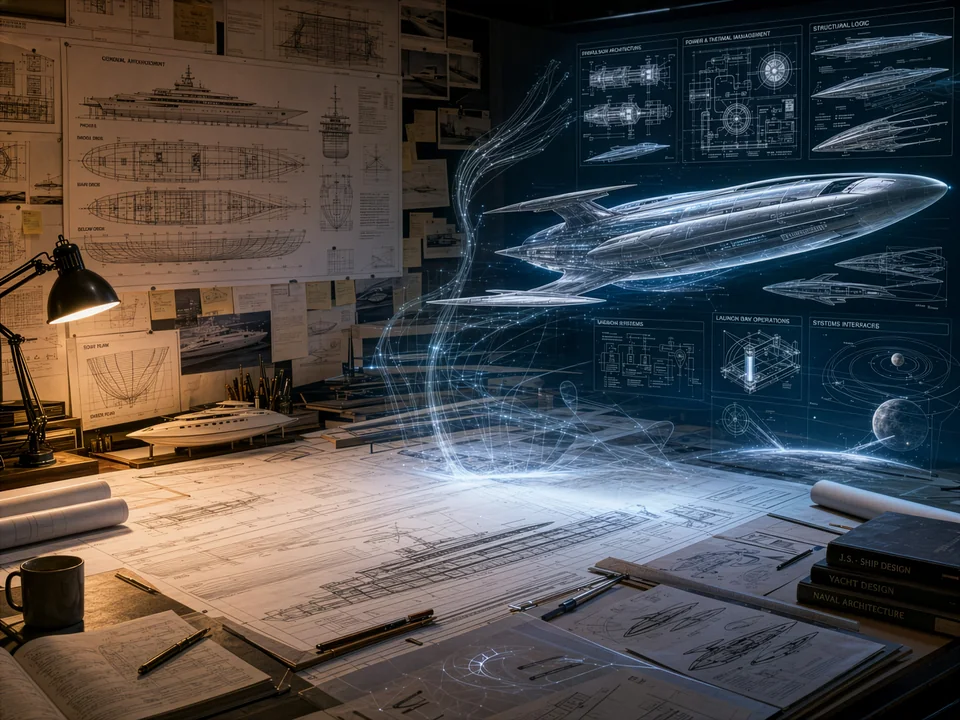
I need to move slightly backward in the timeline here, because the editorial development of the manuscript and the production of the book did not happen one after the other. To a large extent, they ran in parallel.
As the versions after Draft 1.0 developed, another kind of work began growing around P.X as well.
On one side, I was rewriting the novel, carrying out developmental and line edits, tightening sentences, and moving toward the final form of the story. On the other, I was facing an increasingly concrete question:
What was P.X actually going to look like as a book?
I had a manuscript. Hundreds of pages of story, characters, planets, civilizations, and a world built from beginning to end.
But what a reader would eventually hold was not going to be a Word document.
That was the point at which I fully understood, for the first time, that writing a novel and turning that novel into a book were two different jobs.
There were dozens of decisions we barely think about when we pick up a book. What size would the page be? How would the text sit on it? Which typeface would I use? What point size, line spacing, and margins felt right? How should chapters begin? What should headings look like? How should page numbers, blank pages, and section breaks be handled?
I had not thought about any of these things when I began writing the novel.
Now every one of them needed an answer.
That was how the visual structure of P.X began to take shape, from its 6 x 9 inch trim size and typography to chapter openings and the interior page layout. The pages did not merely have to be readable. They also needed a character that belonged to the world of the book.
After a while, I was thinking not only about how the sentences would read, but about how they would appear in front of the reader.
The black-and-white images between sections became part of that process as well. I did not want them to be purely decorative. Each one needed to belong to the atmosphere of the section in which it appeared, offering a small window into the world of the story without breaking the book’s overall visual language.
Then came the cover.
Of course I knew how important a novel’s cover was. But when you actually begin designing one, you understand much more clearly how difficult the problem is.
How do you represent hundreds of pages of story in a single image?
The book needed to read as science fiction, but the cover could not simply look like a poster of a spaceship. It had to suggest the scale of P.X while preserving the mystery of the story. The title needed an identity of its own. And the visual language had to work both as a small cover image on a digital screen and as a physical object in print.
Then I learned that what we call a “cover” is not only the front. There is a back cover, a spine, bleed, trim dimensions, and a barcode area. Paperback and hardcover editions also have different technical requirements.
When the page count changes, the spine thickness changes. When the spine thickness changes, the dimensions of the cover file change too.
That logic felt very familiar.
A change in one place creates consequences somewhere else.
Engineering was back at the table.
Except this time, what I was working on was not a ship. It was my own book.
I designed the cover, the book itself, and P.X’s visual identity. At first, I did not think of this as taking on another profession. I simply saw another problem in front of me that needed to be solved.
There was one principle that came to summarize this entire period:
If you don’t know, you learn.
That did not mean, “I already know how to do everything.”
Quite the opposite. There were many things I did not know.
I was not a book designer. I had never worked in publishing. I had never produced an EPUB. I had never dealt with the technical requirements of a print cover. ISBNs, ASINs, metadata, trim sizes, print-ready PDFs: most of these were not naturally part of my life.
But each of them could be turned into a problem that could be solved.
How is it done?
What is required?
What are the rules?
What can go wrong?
How do I check whether the result is correct?
I researched. I learned. I tried. Sometimes I got it wrong. Then I did it again.
Then the next problem appeared.
At some point, I realized P.X was not even a single product.
The same novel had an ebook edition, a paperback, and a hardcover. To a reader, all three were the same P.X. From a production point of view, they were three different things.
An ebook has no fixed page layout. An EPUB has to behave correctly across different screens and devices. In print, everything is fixed down to the millimeter. Margins, page dimensions, image resolution, and placement matter. A paperback cover is one file. A hardcover brings different calculations and different production requirements.
I also learned that something that looks correct on a screen may not look the same in print.
It was not enough for a file to open and look good.
It had to be producible.
Then came the part the reader almost never sees.
As the independent publishing process moved through Amazon Kindle Direct Publishing, the book needed an invisible identity as well as a visible one: ISBNs, ASINs, edition information, book descriptions, categories, keywords, pricing, print options, and the files required for ebook and print formats.
I came to understand much more clearly that behind the single book you see on a bookstore shelf is a substantial infrastructure of information and production that the reader will never see.
And after all that, there was another stage:
Control.
Preparing and uploading the files did not mean the job was finished.
Preview screens were checked again and again. Page breaks were inspected. Images were reviewed. Cover alignment and dimensions were checked. When something was wrong, the file was revised, exported again, and uploaded again.
Then, when a physical copy arrived, the process started over once more.
Did something that looked right on the screen still look right on paper?
How did the page feel?
Was the text too dense?
Had the images printed as intended?
Was the cover sitting correctly?
Throughout my career, I had learned very well that designing something and having it ready for delivery are not the same thing.
The same rule applied to P.X.
Except this time, the product going through final quality control had my own name on the cover.
As the process continued, it became increasingly difficult to describe exactly what job I was doing. I was the author, and I was the person editing the manuscript again and again. I was also the person designing the interior pages, the cover, and the section artwork. I was the one producing the ebook and print files, preparing the metadata, managing the publishing platform, choosing print options, and carrying out final quality control.
At some point, without really intending to, I had turned into a very small one-person publishing house.
I had not planned it that way. I had not set out thinking, “I am going to write a novel and then manage the entire publishing process myself.” Each need simply followed the one before it: improve the novel, turn it into a book, create the cover and interior design, produce the ebook and print files, and eventually build an entire publishing identity around it. Every time, another job appeared in front of me. I learned how to do it.
Perhaps the strongest habit I carried over from my professional life was this: do not try to solve a large and complex problem all at once.
You solve the next problem in front of you. Then the one after that. Then the next.
After a while, you look back and something that once seemed overwhelmingly complex is standing in front of you as a completed system.
That is what happened with P.X.
For months, I had seen it only on a screen: first as words, then as pages, and later with its cover, typography, artwork, and full design, looking more and more like a real book. I had written P.X, edited it, designed it, and brought it to the point where it was ready to publish.
But I still had never touched it.
At some point, all those files on a screen would need a physical counterpart in the real world.
And for the first time, P.X would arrive in my hands as a book.




Discussion
Please mark book spoilers clearly. First-time comments are reviewed before appearing. Your email remains private.
No comments yet. Share your thoughts below.