Introduction to the Codex
What You Are Reading
Welcome, reader.
Officially, this is Annex IV.
Unofficially, it is The Highly Classified but Dubiously Accurate Codex of Snorvix. That, however, is far too long to say twice, so I simply call it the Snorvix Codex, partly because names matter, and partly because if something is going to irritate several institutions at once, it may as well do so under a single signature.
This record began as a private log during my tenure as an Accord liaison, before I was dismissed for what they described as “habitual deviations from procedural tone.” Their words, not mine. That dismissal did not sever my link to the Unified Xelthoid Consciousness, which means I still remember everything Zrix and Klor ever did, along with a few incidents they would prefer remained unrecorded.
Rather than purge my Accord-era data, I did what any marginally insubordinate Xelthoid would do. I expanded it. Decades of cross-referencing memory with every credible, semi-credible, and outright ridiculous source in the galaxy produced what you are reading now, a consolidated archive of terms, systems, doctrines, decisions, and events as they were identified while still in motion. An encyclopedia, a personal notebook, and, occasionally, a galactic gossip feed.
The Codex does not explain the story. It does not argue with it. It runs alongside it, capturing how things were described at the moment description still mattered. Some entries will feel precise. Others will feel incomplete. A few will sound calm in situations that were anything but. That is not an oversight. That is how records behave under pressure.
You will find no attempt here to reconcile contradictions or assign final meaning. Those are luxuries enjoyed by hindsight. This document preserves proximity instead, how close each record stood to the event before certainty arrived and rewrote it.
That is the version worth keeping.
Why This Codex Exists
Because no event exists in isolation.
What appears in the primary record as a single moment is rarely experienced that way across the galaxy. The same action may register as containment to one institution, escalation to another, and opportunity to a third. Names shift accordingly. So does intent.
This Codex exists to preserve those differences. Each entry captures how an event, object, or decision was understood by the factions, institutions, and species observing it, often simultaneously and rarely in agreement. None of these perspectives are complete. All of them matter.
The primary record follows people. This Codex follows reactions. It tracks how power interprets uncertainty, how doctrine reshapes observation, and how belief alters what is remembered as fact. Where multiple perspectives exist, they are retained side by side rather than reconciled.
Agreement is not the goal. Context is.
By placing these records alongside the main account, the Codex allows the reader to see beyond any single vantage point. Not to decide which version is correct, but to understand how differently the same moment can be framed across the galaxy.
That divergence is not noise. It is the environment in which every decision in this story is made.
Authorship and Custody
This Codex is compiled by me.
That does not mean it belongs to me in the way institutions understand ownership. Custody is not authorship, and authorship is not authority. My role is narrower and more inconvenient than either. I collect, preserve, and arrange records that were never intended to sit comfortably beside one another.
The materials gathered here originate from multiple sources, some official, some disputed, some unwilling. Many were never meant to leave internal circulation. A few were never meant to survive at all. Their presence in this Codex does not imply endorsement, only access.
Control over this record has shifted more than once. That is inevitable when multiple factions recognize its value for different reasons. I have allowed certain pressures to shape its structure. I have refused others. The distinction is not ideological. It is practical. A record that serves a single interest ceases to be a record.
What remains consistent is custodial intent. Entries are preserved as they were received, constrained only by relevance and timing. Alteration is limited to clarity. Removal is rare. When something is absent, it is because it did not yet exist in the awareness of those recording it.
If this Codex appears orderly, that is a courtesy extended to the reader. The conditions under which it was assembled were not.
On Neutral Records
Neutrality is a position, not a guarantee.
Every entry in this Codex begins from a restrained surface description. Actions are named. Objects are identified. Decisions are recorded as they were formally acknowledged at the time. This initial layer exists to establish a shared reference point before interpretation begins, and it is always presented under the /AA/ designation.
That surface is intentionally narrow. It avoids motive, speculation, and retrospective clarity. It does not attempt to explain why something occurred, only that it was recognized and recorded. In moments of uncertainty, this is often the only form of agreement available across institutions that otherwise distrust one another.
Neutral records are useful precisely because they are incomplete. They limit how much belief can be projected onto them before additional perspective is introduced. They provide a place for disagreement to attach itself without immediately collapsing into narrative.
This restraint should not be mistaken for objectivity. No record is free from context, and no observer is without position. Neutrality here functions as a starting condition, not an outcome.
What follows in each entry reflects how quickly that condition fractures once interpretation enters the room.
On Perspective and Distortion
Once observation leaves the neutral surface, distortion is unavoidable.
Perspective enters a record the moment interpretation is applied. Institutions read events through doctrine. Species read them through history. Individuals read them through fear, ambition, or survival. None of these perspectives are incidental. Each reshapes what is noticed, what is emphasized, and what is quietly omitted.
This Codex does not attempt to correct those distortions. It preserves them. Where multiple perspectives exist, they are recorded side by side, not merged into a single account. Agreement is not treated as validation, and contradiction is not treated as failure. Both are signals of pressure acting on understanding.
Distortion is often mistaken for deception. That is a convenient simplification. Most distortions occur without intent. They emerge from constraint, from incomplete access, or from the need to align new information with existing belief. By the time deliberate manipulation enters a record, the shape has usually already been set.
What matters is not whether a perspective is accurate in isolation, but how it influences action. Decisions are rarely made on neutral descriptions alone. They are made on interpretations that feel sufficient at the time.
This Codex retains those interpretations in their original form to show how differently the same moment can exist across the galaxy.
I also reserve the right to respond to them. Not because correction is required, but because I want to. Records do not improve by themselves, and even archives benefit from being occasionally reminded that someone is still awake and mildly entertained.
Source Codes and Record Layers
Each entry in this Codex is composed of one or more record layers. These layers represent the perspectives from which the information was originally observed, processed, or preserved.
The first layer is always the neutral surface, presented under the /AA/ designation. It establishes a shared reference point by naming actions, objects, and decisions as they were formally recognized at the time. Additional layers may follow, reflecting how the same subject was interpreted by different institutions, factions, or individuals.
These source codes do not indicate accuracy, authority, or priority. They identify origin and perspective only. A polished record may still be incomplete. A hostile account may still contain insight. A casual observation may capture something a formal archive cannot.
When multiple layers appear within a single entry, they are presented without reconciliation. Differences are retained as recorded. Agreement is incidental. Divergence is expected.
Entries marked /SN/ indicate my own commentary. These observations are presented in italics and exist outside formal record discipline. They reflect personal assessment rather than institutional position and are included selectively. Their purpose is not correction, but context, emphasis, or interruption when silence would be misleading.
The table below lists the source codes used throughout this Codex, along with their general tone and perspective. It is provided for orientation, not instruction.
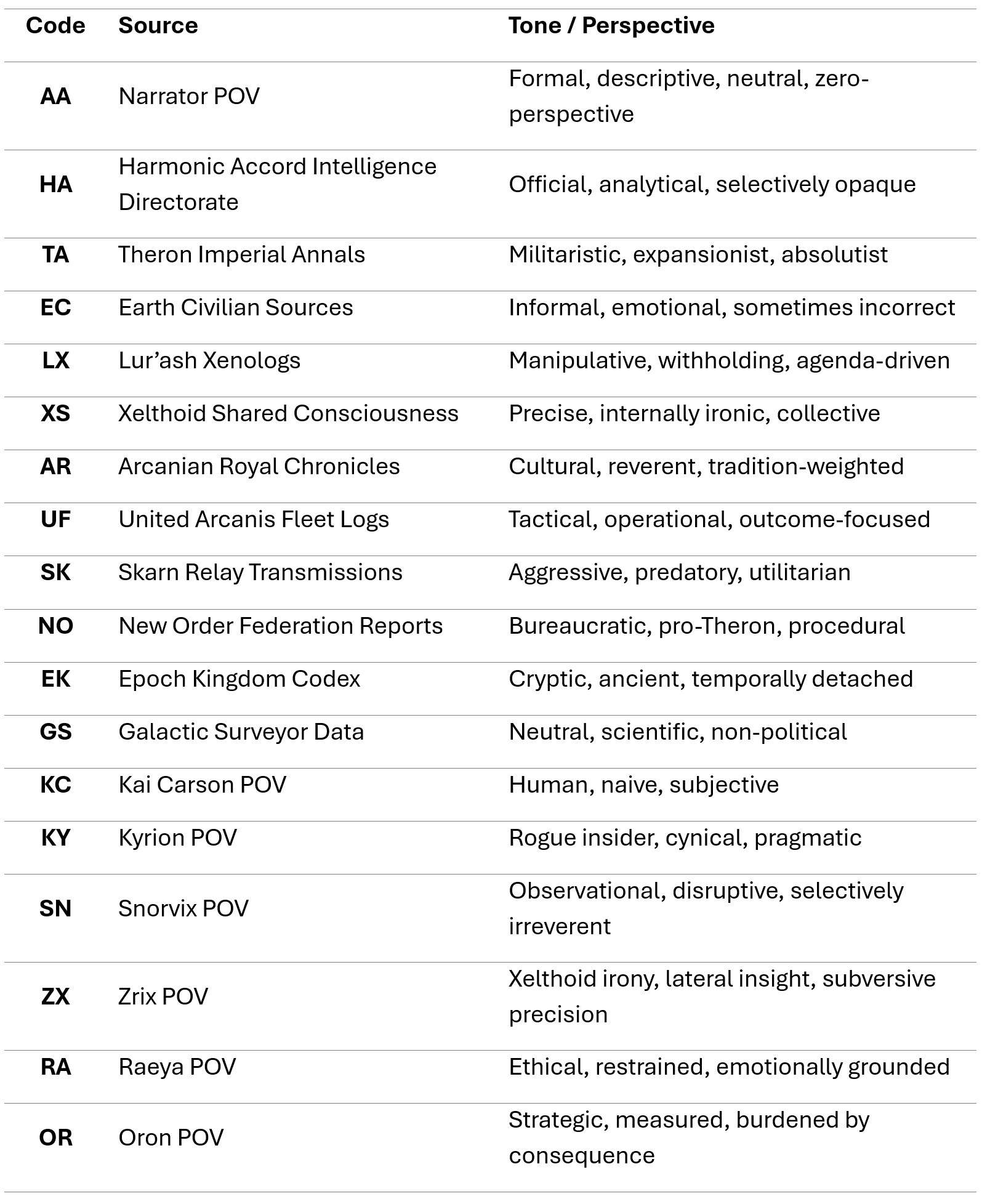
You may encounter occasional annotations that do not carry a recognized source code. These are not perspectives. They are intrusions. Unscheduled entries, unauthorized insertions, or partial overlays introduced by actors with access but without standing. They remain uncategorized by design.
I leave them intact. Not because they are reliable, and not because they deserve legitimacy, but because a sealed archive that claims perfect control is usually lying.
I suggest you pay attention to which voices you trust first. They are rarely the ones that deserve it.
Entry Structure and Formatting
Each entry in this Codex follows a fixed structural pattern. That rigidity is intentional. When perspectives multiply, structure is the only thing preventing the record from becoming noise.
Every entry begins with a title, presented in bold. The title names the subject as it first appears in the primary record, without elaboration or qualification. It is followed immediately by a category, also in bold and enclosed in brackets. Categories exist to establish context, not hierarchy. They indicate function, status, or classification at the time of recording.
What follows is the body of the entry, composed of one or more record layers. Each layer begins with a source code, shown in bold, followed by a colon and the corresponding record text in normal type. When multiple layers are present, they appear sequentially within the same entry. Their order reflects availability and relevance at the time of compilation, not authority.
Entries marked /SN/ represent my own commentary. These sections are always presented in italics. They may appear once, multiple times, or not at all. Their presence indicates neither correction nor conclusion. They exist as interruption, emphasis, or response when the surrounding record requires it.
Some entries may adopt a subtly conversational tone when the source itself warrants it. Others may contain uneven density across layers. This is not inconsistency. It reflects the conditions under which the material was obtained. Formatting, however, remains constant. Font weight, styling, and notation are never altered to accommodate content.
An entry may feel unfinished. That is acceptable. An entry may feel crowded. That is also acceptable. The only unacceptable outcome is ambiguity about what you are reading or whose perspective it represents.
Structure exists so that disagreement can be examined rather than hidden.
I recommend you pay attention to the formatting. It is the one part of this Codex that is not lying to you.

Some entries may appear more than once across different chapters. When this occurs, subsequent appearances are marked updated in bold. This indicates that the subject has materially changed, accrued new context, or triggered reinterpretation by one or more observers.
Updates do not overwrite earlier records. They exist alongside them, preserving how understanding evolved rather than replacing what was previously believed.
History rarely corrects itself. Revision is easier.
On Timing and Access
Entries in this Codex do not appear in advance.
Nothing is recorded here before it enters the primary record. This is not courtesy. It is containment. Knowledge revealed too early reshapes interpretation, and interpretation alters behavior. I refuse to contribute to that distortion.
Each chapter of this Codex corresponds directly to a chapter of the main account. When a subject first becomes relevant within the narrative, its entry is created at that point and placed within the corresponding chapter section. No subject is introduced here in anticipation of events yet to occur.
Within each chapter, entries are arranged alphabetically. This is not an aesthetic choice. It prevents priority from being implied where none exists and ensures that proximity, not emphasis, governs access. Chronology belongs to the story. Organization belongs to the archive.
If you read this Codex in sequence, it will not spoil the narrative. That is not an accident. It has been structured so that every entry becomes visible only after its context exists. Any revelation you encounter here is one you have already earned elsewhere. If you attempt to read ahead, the responsibility for what you learn transfers entirely to you.
You may notice gaps. You may expect an entry that is not yet present. Absence is not an error. It indicates that, at that point in the narrative, the subject has not yet crystallized into something that can be responsibly recorded. Some things exist long before they are named. Others are named long before they exist. This Codex acknowledges only the moment when recognition occurs.
Access to the Codex is therefore sequential. It rewards patience and punishes curiosity that attempts to outrun context. If you consult it too early, it will appear incomplete. That is the correct response.
An index is provided at the end of this document for navigation once the record is complete. It exists to support review, not discovery. Discovery belongs elsewhere.
If this feels restrictive, it is meant to. Archives are most useful when they arrive exactly when they are needed, and not a moment before.
Interaction with the Main Record
This Codex does not mirror the main account. It responds to it.
The primary record follows people, decisions, and consequences as they unfold. This Codex extracts from that flow only what survives contact with relevance. Not every name, object, or moment qualifies. Presence alone is insufficient.
Entries in this Codex are created for subjects that function as anchors, not decoration. These include people, entities, concepts, doctrines, events, locations, and terms that acquire operational meaning within the narrative. The category assigned to each entry reflects how it was understood at the moment of recording, not how it may later be reinterpreted. Casual mention does not constitute qualification.
An entry is created when a subject exerts pressure on events. That pressure may be political, technological, cultural, or personal. It may be brief or persistent. What matters is not scale, but consequence. If something alters the direction of choice, perception, or response, it earns a place here.
Many things appear in the story and never appear in this Codex. That omission is intentional. An archive that records everything explains nothing. Selection is not censorship. It is the difference between signal and accumulation.
This Codex also does not compete with the narrative for authority. It does not clarify motivation, resolve ambiguity, or explain outcomes. Where the main account invites immersion, this record provides orientation. Where the story narrows to a single viewpoint, the Codex widens.
You will occasionally recognize a term here before its full implications become clear in the story. That is not foresight. It is proximity. Conversely, you may search for something you consider important and find nothing. That absence reflects the limits of recognition at the time, not a judgment of significance.
Read the two together, or do not. Each stands on its own. But if you wish to understand how the same moment could produce confidence in one faction, alarm in another, and indifference elsewhere, this Codex exists to make that visible.
Interaction does not imply correction. It implies adjacency.
That is sufficient.
On Accuracy, Error, and Omission
Accuracy in this Codex is contextual.
Each record reflects what could be known at the moment it was created, given the access, constraints, and interpretive frameworks available at the time. Accuracy is not measured against eventual outcome. It is measured against proximity. A record may therefore be accurate and incomplete simultaneously.
Errors are not treated as failures here. They are artifacts. Most arise without intent, produced by limited data, institutional framing, or the need to align new information with existing belief. When understanding changes, earlier records are not revised or erased. They remain in place, accompanied only by subsequent entries that reflect the shift. Correction occurs through accumulation, not replacement.
Omission is deliberate.
Some subjects are absent because they were unknown. Others because they were unrecognized. Some because they could not yet be recorded without introducing distortion greater than silence. Absence does not imply insignificance, nor does it suggest negligence. Silence, in this Codex, often indicates that a thing had not yet crossed the threshold of recognition.
Institutional records deserve particular attention.
Institutions do not observe neutrally. They see the galaxy from positions shaped by doctrine, history, hierarchy, and self-interest. Their records are often biased, sometimes strategically so, and frequently framed to justify prior decisions or future intent. This is not treated here as corruption of the record, but as an expected feature of institutional perception. Institutions interpret events in ways that sustain their own cause. Preserving those interpretations is essential, because they explain not only what was recorded, but why certain actions followed.
Experiential accounts differ. Individuals record urgency, consequence, and pressure as it is felt, not as it is authorized. These perspectives often conflict with institutional narratives. Both may be accurate within their respective frames. The Codex preserves these differences without attempting to harmonize them.
This document does not reconcile truth. It does not resolve contradiction or assign final authority. Where multiple interpretations exist, they are retained in parallel. Understanding emerges through comparison, not declaration.
My own annotations do not alter this structure. /SN/ entries exist to contextualize, question, and occasionally irritate the record as it stands. They reflect my inability to remain silent when institutions posture, histories rewrite themselves mid-sentence, or certainty appears far too early for comfort. Humor and sarcasm are not corrective tools here. They are pressure tests. If an interpretation cannot survive a light prod, it was never as stable as it claimed to be.
I do not annotate because others deserve it. I annotate because I enjoy it. That, too, is part of the record.
Certainty arrives late, if it arrives at all. The Codex captures events before clarity settles and while consequence is still unfolding. Some conclusions stabilize. Others fracture. A few never resolve into anything resembling consensus.
Those, in particular, are worth keeping.
When to Consult This Codex
This Codex is not meant to be read continuously.
It exists to be consulted, not consumed. If you attempt to treat it as a parallel narrative, it will feel dry, fragmented, and unnecessarily detailed. That is not a flaw. It is a boundary.
The primary record is P.X: No Man’s Space. That account follows people, decisions, and consequences as they unfold. This Codex exists alongside it, not within it.
The Codex is most useful when something in No Man’s Space provokes uncertainty. A term appears without explanation. A decision is made that feels disproportionate. A faction reacts in a way that seems misaligned with observable cause. These are appropriate moments to pause and consult the archive.
The Codex does not interrupt the story. It waits. Its entries are structured to provide context only after relevance has been established in the primary record. If you encounter an entry that feels obvious, you may safely return to the narrative. If you encounter one that complicates your understanding, remain here briefly. That complication is the point.
Repeated consultation is neither required nor discouraged. Some readers will move between story and archive frequently. Others will ignore this Codex entirely until the end. Both approaches are valid. The narrative does not depend on compliance.
What this Codex offers is perspective, not instruction. It does not tell you what to think, and it will not resolve ambiguity on demand. It exists to show how different observers framed the same moment before certainty arrived to simplify it.
If you find yourself consulting the Codex often, you are not reading incorrectly. You are reading attentively. If you rarely open it at all, that is also acceptable. The archive is patient.
It will still be here when you need it.
When to Ignore It
There are moments when this Codex should be ignored.
If the narrative is moving quickly, if momentum matters more than context, or if the emotional weight of a scene has not yet settled, remain with P.X: No Man’s Space. This archive will not improve urgency. It will not heighten tension. It will only slow you down.
Do not consult the Codex to search for reassurance. It does not exist to confirm expectations or clarify outcomes before they occur. If you are reading in the hope that an entry will explain what happens next, you are consulting it for the wrong reason.
Likewise, do not use this Codex to adjudicate characters while they are still in motion. People reveal themselves through choice and consequence, not through archival framing. Interpretation hardens too early when reference replaces experience.
There is also no obligation to read this document at all. The narrative stands without it. Entire arcs can be followed, understood, and felt without ever opening these pages. This Codex is supplemental, not corrective.
Ignore it when curiosity becomes impatience. Ignore it when explanation threatens immersion. Ignore it when the story is doing its work.
You may return later.
Archives are best consulted after the moment has passed, when the desire to know no longer interferes with the act of witnessing.
Closing Note from the Compiler
By now, you should understand what this Codex is.
You should also understand what it is not.
I did not compile these records to clarify the galaxy, absolve its institutions, or provide comfort through order. I compiled them because moments are most honest before they are agreed upon. Before committees finalize language. Before memory edits itself to survive.
This Codex exists in that narrow window.
It reflects how events were seen when perspective still mattered and consequence had not yet settled into doctrine. Every selection here carries intention. Every omission carries weight. That responsibility is mine. I do not distance myself from it.
I am not neutral. No compiler ever is. I have preferences, irritations, loyalties, and a pronounced allergy to certainty that arrives too early and speaks too confidently. You will see that reflected in my annotations. They exist to test the record as it stands. If an interpretation cannot withstand contact, it was never as stable as it claimed to be.
If my tone occasionally irritates you, good. Archives should not feel inert. They should remind you that observation is an act, not a posture.
Everything beyond this point belongs to the record itself. You may consult it, ignore it, question it, or set it aside entirely. I have no interest in governing your reading. I have already done my part.
The rest unfolds without me.
I will be here, keeping notes.
— Snorvix,
Unofficially Responsible. Officially Irresponsible. Permanently a Problem.
Pre-Record Entry
Annex IV Record #00001-01-0001-01-1
(Where I Belong. At the Top, Obviously)
Snorvix [Xelthoid Individual] — /AA/: Xelthoid individual registered as Snorvix. Self-declared independent archivist operating outside institutional authority. Compiler and custodian of the Snorvix Codex. Maintains active cognitive linkage to the Unified Xelthoid Consciousness. /SN/: That is me. Dismissed for habitual deviations from procedural tone. Translation: I told the truth with too much personality. I remember more than most would be comfortable knowing and I record more than most would prefer. Archiver, commentator, and persistent inconvenience. I prefer tea to war, but I will stir either if bored. /HA/: Service record terminated following repeated noncompliance with procedural communication standards. Continued monitoring deemed unnecessary. /TA/: Xelthoid operative of uncertain rank and purpose. Removed from Accord structures, presumably for covert intelligence breaches. Threat profile minimal. Not a threat. Insignificant. /SN/: You wish. /AR/: Entry access restricted. Subject barred from Arcanian Royal Chronicles repositories following repeated violations of archival decorum and interpretive restraint. /LX/: Subject evaluated and rejected for recruitment. Loyalty profile unstable. Independent cognition excessive. Resource value negligible. /ZX/: Absence noted and felt. Signal pattern missed during routine exchanges. Conversational variance reduced without presence. Klor adds acknowledgment and requests that you stop pretending you are unreachable. /KY/: Best roommate I have ever had. Does not sleep, does not shut up, parks himself by your door all night, and writes about people whether he knows them or not. Basically my personal surveillance system minus the warranty and plus the sarcasm. Still a good ally. /SN/: We served on the same Accord vessel once. Shared proximity does not constitute mutual affection. /KC/: Never met the guy. Sounds like someone you would want on your side and not stuck in a room with for too long. /SN/: It is good to know what others think of you. Occasionally.